
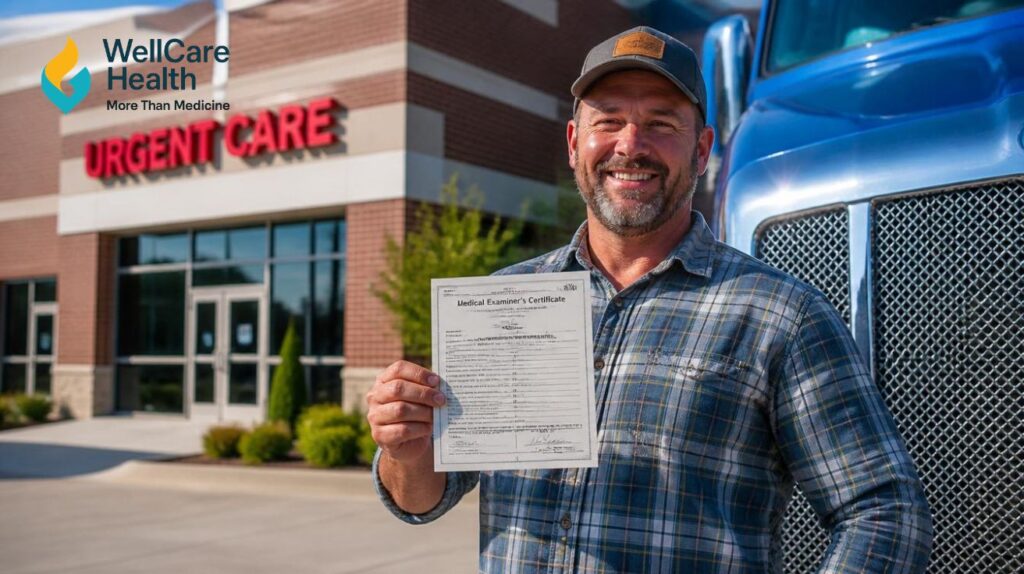
Your CDL medical certificate expires in three weeks. Your dispatcher just flagged that you’re overdue. Or you’re applying for a new driving position and need a signed MCSA-5876 before you can start.
Whatever brought you here, the goal is the same: get your DOT physical done right, done fast, and done by a certified examiner without driving across the city or waiting a week for an appointment.
This guide covers everything Chicago-area commercial drivers need to know: what’s tested, what disqualifies you, what changed with the FMCSA’s new electronic reporting system in 2026, and how to walk out of a North Side walk-in clinic same-day with your certification.
What Is a DOT Physical and Who Needs One?
A DOT physical formally called the FMCSA Commercial Driver Medical Examination is a federally mandated health screening that determines whether a commercial driver is physically, mentally, and emotionally qualified to safely operate a commercial motor vehicle (CMV). It is governed by 49 CFR Part 391, Subpart E and must be performed by a medical examiner listed on the FMCSA National Registry of Certified Medical Examiners (NRCME).
You need a current DOT medical certificate if you operate any of the following in interstate or intrastate commerce:
- A vehicle with a gross vehicle weight rating (GVWR) over 10,001 pounds
- A vehicle designed or used to transport 16 or more passengers (including the driver)
- A vehicle transporting hazardous materials in quantities requiring placarding
This covers semi-trucks, tractor-trailers, flatbeds, box trucks over the weight threshold, passenger vans, school buses, and most commercial delivery vehicles. If you hold a CDL Class A, B, or C license and operate commercially, you need a valid medical certificate.
How often? Most certifications are valid for 24 months (two years). However, the examiner may issue a shorter certificate of 12 months, 6 months, or 3 months if a health condition warrants closer monitoring.
What the 2026 DOT Physical Actually Tests
The exam works through ten clinical categories under FMCSA standards. A certified medical examiner covers each one systematically:
- VisionEach eye must test at20/40 or better, with or without corrective lenses. You must also have at least 70 degrees of peripheral vision in each eye and the ability to distinguish traffic signal colors. Bring your glasses or contacts if you use them the exam tests corrected vision, but your certificate will note whether correction is required.
- HearingYou must be able to perceive a forced whispered voice atfive feet or greater in at least one ear, with or without a hearing aid. An audiometric test is an acceptable alternative.
- Blood pressure and pulseThis is the most common reason drivers receive shortened certifications rather than the full two-year card. The thresholds:
| Blood Pressure Reading | Certification Outcome |
|---|---|
| Below 140/90 | Full 24-month certification |
| 140–159 / 90–99 (Stage 1 hypertension) | 12-month certification |
| 160–179 / 100–109 (Stage 2 hypertension) | 3-month conditional certification |
| 180/110 or above (Stage 3) | Disqualified until controlled |
If you know your blood pressure runs high, get it checked and treated before your exam. Arriving with controlled, documented hypertension is far better than receiving a disqualifying reading that pulls you off the road.
- UrinalysisA urine sample screens for underlying conditions — primarily diabetes (glucose) and kidney disease (protein). This isnot a drug screen. Drug testing is a separate employer-mandated process under DOT Part 40. Do not confuse the two.
- Physical examinationTheexaminer reviews your general appearance, eyes, ears, mouth and throat, cardiovascular system, lungs, abdomen, spine, musculoskeletal system, and neurological function everything relevant to your ability to safely control a commercial vehicle.
- Medical history reviewYou’ll complete theMCSA-5875 before the exam begins. This federal form asks about your history of heart disease, seizures, diabetes, sleep apnea, psychiatric conditions, substance use, and any surgeries or hospitalizations. Be thorough and accurate misrepresentation on this form is a federal violation and can result in CDL disqualification independent of your exam results.
Conditions That Can Disqualify You — and Exemptions That Exist
The FMCSA’s 49 CFR §391.41 lists definitive disqualifying conditions. The ones Chicago-area drivers most commonly encounter:
Conditions that disqualify without an exemption:
- Current diagnosis of epilepsy or seizure within the past 8 years
- Vision below 20/40 in both eyes uncorrectable to standard
- Blood pressure above 180/110 at time of exam (until treated)
- Current insulin-dependent diabetes (unless FMCSA diabetes exemption is approved)
- Use of a Schedule I controlled substance, methadone, or unprescribed amphetamines
- Diagnosis of clinical alcoholism
- Respiratory or cardiovascular disease likely to impair safe driving
Conditions that are certifiable with proper documentation:
- Well-controlled hypertension on medication — bring your prescription list and recent readings
- Type 2 diabetes managed with oral medication — generally certifiable with supporting records
- Sleep apnea with documented CPAP compliance — bring your device’s compliance report for the last 90 days
- Stable, treated mental health conditions — bring psychiatric records confirming current stability
- Past cardiac history (stents, bypass, arrhythmia) — a cardiology clearance letter prevents delays
FMCSA exemption programs exist for vision, insulin-treated diabetes, hearing, and seizure disorders. These require a separate application to FMCSA not something resolved at the clinic. If you’ve been granted an exemption, bring that documentation to every exam.
The critical thing to understand: a manageable condition with proper documentation is entirely different from a disqualifying condition. Many drivers delay their exam because of a condition that’s actually certifiable. Arrive with records, not assumptions.

The 2026 Change Every Chicago CDL Driver Needs to Know
The most significant update to DOT physicals in 2026 is not a new medical standard it’s how your certification is transmitted and proven.
Under National Registry II (NRII), certified medical examiners are now required to transmit exam results electronically to the FMCSA National Registry by the next calendar day. The FMCSA then shares your medical certification status directly with state licensing agencies. In Illinois, that means your record is updated in the Secretary of State’s CDLIS system automatically — without you needing to hand-carry a paper card to your employer.
The FMCSA issued a temporary waiver through April 2026 allowing drivers to use a paper copy of the Medical Examiner’s Certificate (MCSA-5876) for up to 60 days in transitional situations. As of mid-2026, electronic reporting is the expected standard. Your Motor Vehicle Record (MVR) is now the primary compliance proof — not the physical card in your wallet.
What this means practically:
- Use a clinic that is actively listed on the FMCSA National Registry and submits results electronically
- After your exam, verify your updated certification status on your Illinois MVR within a few business days
- Keep a paper copy of your MCSA-5876 as a backup during the transition period
- Employer MVR monitoring systems should reflect your updated status within 1–3 business days of your exam
What to Bring to Your DOT Physical
Arriving prepared is the most controllable factor in your exam outcome. Bring:
Required:
- Valid government-issued photo ID
- Your CDL or commercial learner’s permit (CLP)
- Complete list of all current medications — names, dosages, and prescribing provider
Strongly recommended:
- Corrective lenses or hearing aids if you use them for driving
- Recent blood pressure readings if you take BP medication
- CPAP compliance report (last 90 days) if diagnosed with sleep apnea
- Cardiology clearance letter if you have a history of cardiac events, stents, or bypass surgery
- Recent HbA1c or blood glucose log if you have diabetes
- FMCSA exemption documentation if applicable
Avoid before the exam:
- Excessive caffeine in the hours before (can temporarily elevate blood pressure and pulse)
- Skipping your prescribed blood pressure medication take it as normal on exam day
- Arriving without your medication list; an incomplete medical history form slows everything down
How Long Does a DOT Physical Take?
At a walk-in urgent care clinic with a certified medical examiner on-site, most DOT physicals take 30 to 60 minutes from check-in to receiving your signed MCSA-5876. This includes the medical history form, clinical exam, urinalysis, and certification paperwork.
Arriving with all documentation ready is the fastest path to a same-day result. If a borderline blood pressure reading requires a second measurement after rest, or if documentation review takes additional time, the process may run longer.
What Does a DOT Physical Cost in Chicago?
DOT physicals are not typically covered by personal health insurance, as they are occupational examinations rather than personal healthcare. Most drivers pay out of pocket; some employers reimburse the cost directly.
Independent, community-based urgent care clinics on Chicago’s North Side typically price DOT physicals at the lower end of this range compared to hospital-affiliated occupational health programs. Walk-in pricing with no appointment required makes it easier to fit the exam into an irregular driving schedule.
WellCare Health Clinic offers transparent self-pay pricing for DOT physicals. Check the accepted insurance page to see if your occupational health plan or employer insurance covers the exam some employer-sponsored plans do cover DOT physicals as a workplace health benefit.
Getting Your DOT Physical in Chicago: West Ridge and the North Side
Commercial drivers working routes on I-90/94, I-290, or the North Shore freight corridors will find WellCare Health Clinic a convenient option with no appointment required.
Location: 2553 W Peterson Ave, Chicago, IL 60659 West Ridge neighborhood, North Side. Easy access from Western Ave (just west of the intersection), with street parking on Peterson Ave and the adjacent side streets.
What’s available on-site: The clinical services page includes DOT physicals alongside X-ray and lab services relevant if your employer or a borderline health finding requires additional testing at the same visit.
Hours and transit: The clinic is open seven days a week. Full hours, driving directions, and transit options (CTA #84 Peterson bus, #49B Western) are on the location and hours page.
New to the clinic? The patient resources page covers what to expect, how to access lab results, and how to pay your bill online — useful for drivers who need documentation sent to their employer after the visit.
If you have questions about what to bring or want to confirm DOT physical availability before driving in, the contact page has the direct line.
Frequently Asked Questions
Can my personal doctor do my DOT physical?
Only if your personal physician is listed on the FMCSA National Registry of Certified Medical Examiners. Most general practitioners are not NRCME certified. A walk-in urgent care clinic with a certified examiner on staff is often faster and more reliable than trying to confirm your family doctor’s registry status.
What happens if I fail my DOT physical?
You cannot legally operate a CMV until the disqualifying condition is addressed and you pass a new examination. The path forward depends on why you failed. For high blood pressure, a 3-month conditional certificate may be issued to give you time for treatment. For other conditions, you’ll need to resolve the issue and return for a new exam. The examiner will explain your specific next steps.
Can I get the DOT physical and drug screen done at the same time?
Yes. Many walk-in clinics can perform both at the same visit. The DOT physical urinalysis and the employer-mandated DOT drug test are separate processes clarify with the front desk whether your employer’s drug screen order needs to be coordinated separately.
How soon does my certification appear in the FMCSA system?
Under NRII, your examiner submits results electronically by the next calendar day. Your Illinois MVR should reflect the updated certification within 1–3 business days. If it hasn’t updated after five business days, contact the clinic to confirm the transmission was completed.
My medical card expires in two weeks. Is it too late to renew?
No. You can renew at any point. There’s no penalty for renewing early, and same-day walk-in exams are available. Don’t wait until expiration — an expired certificate can pull you out of service the same day it lapses.
The Bottom Line
A DOT physical is not optional, and an expired medical certificate is a compliance violation that can pull you off the road immediately. In Chicago, same-day exams are available at walk-in urgent care clinics with NRCME-certified examiners no appointment, no week-long wait, and straightforward self-pay pricing.
Arrive with your medication list, bring any relevant medical records for conditions you’re monitoring, and give yourself 30–60 minutes. Most drivers leave same-day with their signed MCSA-5876 and their certification on file.
WellCare Health Clinic is located at 2553 W Peterson Ave, Chicago, IL 60659, open seven days a week. Walk in or contact us with questions before you come.
Disclaimer: This article is for informational purposes only and does not constitute legal, regulatory, or medical advice. DOT physical requirements are governed by FMCSA regulations under 49 CFR Part 391, which are subject to change. Always verify current standards with the FMCSA National Registry and confirm your employer’s specific requirements before your exam.